
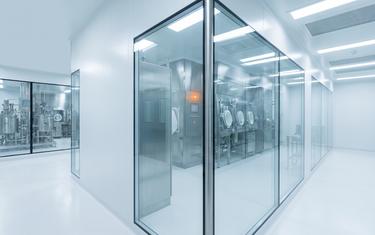
AI-generated industry illustration. No LAPP products depicted.
Cleanroom and hygienic-zone Ethernet cabling is a materials decision before it is a data-rate decision. The room's ISO 14644-1 class describes the cleanliness of its air, not the cable, so shedding and outgassing have to be evidenced by that cable's own test data against the method and acceptance criteria the project applies, and the connector's seal checked against repeated washdown or clean-in-place cycles rather than a general dust and splash rating. Get the protocol and the Cat rating right first, then verify the materials on their own evidence.
The protocol side is covered in our PROFINET cable selection guide and the performance side in the Cat.5e to Cat.6A patch cord guide, while the semiconductor fab case is covered in Semiconductor Fab Connectivity. This piece broadens that last one beyond the fab, into the pharmaceutical, biotech and medical-device zones where the same question arrives with different chemistry.
What makes a data cable cleanroom-compatible beyond its data rate?
A cable that meets its Cat rating and runs the right protocol has answered the electrical question and none of the environmental one. Inside a controlled space the cable becomes another potential contributor to the airborne particles and chemical emissions in the room, and the room is classified on airborne particle concentration.
Two properties matter here that an ordinary panel never asks about. The first is particle shedding: the whole construction, jacket, fillers and any textile elements, can release particles during installation flexing, which is a non-issue in a control cabinet and directly relevant where airborne particle count is what gets audited. The second is outgassing, where a compound releases volatile substances over time, which matters in spaces built around chemical concentration limits.
Neither can be inferred from the data rating or from the fact that the network works electrically. They are separate checks, evidenced by that cable's own test data against the applicable method and the project's acceptance criteria. A cable can be fully Cat-compliant and still be the wrong material for the room.
This is where ETHERLINE® industrial Ethernet cable and UNITRONIC® data cable come in, with one caveat worth stating plainly. UNITRONIC® is a signal and data cable family rather than a general label for Ethernet, so the variant matters. Whether a given ETHERLINE® or UNITRONIC® part suits a low-outgassing or cleanroom-adjacent duty belongs on that part's datasheet and test reports, not on the family name.
Take a retrofit as an illustration. A biotech line adds connectivity to a space that passed its last audit before any of that cabling existed. The network design can be sound electrically and still introduce a jacket compound that sheds during the pull, which is the kind of material choice a re-qualification is built to catch. Checking the shedding and outgassing evidence before the order is cheaper than finding it at re-audit, though how much cheaper depends entirely on what the requalification costs that site.
How does the room's ISO 14644 class relate to cable and connector selection?
ISO 14644-1 classifies a cleanroom or clean zone by the concentration of airborne particles in its air. That is what the class does. It describes the air, at stated particle sizes and counts, and nothing in it certifies a cable or sets a cable's outgassing limit.
So the relationship runs one way and loosely. The room's class tells an engineer how clean the air has to stay, which raises the bar on what is acceptable inside it, but a cable does not inherit a room class. Passing a particle check does not by itself establish outgassing behaviour, biological suitability, chemical resistance or washdown durability. Those are separate questions with separate evidence.
The rest of the series is where equipment actually gets assessed. ISO 14644-14 covers assessment of the suitability for use of equipment by airborne particle concentration, and ISO 14644-15 covers assessment of equipment and materials by airborne chemical concentration. Both are worth naming precisely, because each states what it does not cover: Part 14 excludes cleanability, material selection and biocontamination, and Part 15 excludes cleaning-agent compatibility and cleanability.
The table below separates references that are often cited together as if they answered one question.
| Reference or evidence | What it addresses | What it does not establish |
|---|---|---|
| ISO 14644-1 | Classifies air cleanliness in a room or zone by airborne particle concentration | Any qualification of a cable, connector or gland |
| ISO 14644-14 | Assesses whether equipment is suitable for use, by airborne particle concentration | Cleanability, material selection or biocontamination, which it excludes |
| ISO 14644-15 | Assesses equipment and materials by airborne chemical concentration | Cleaning-agent compatibility or cleanability, which it excludes |
| The cable's own test data | Shedding and outgassing behaviour of that construction, under the method used | The class of the room the cable runs in |
| An IP rating on the connector | Ingress resistance under that rating's defined test | Chemical durability against the cleaning agent, or surface cleanability |
Read together, the room standards and the product evidence sit in separate layers. Treating a room class as a stamp on the cable is the specific error this section exists to prevent, and the same applies in reverse: a cable with good test data does not make the room compliant.
Out of scope for the cabling decision, and worth naming so the boundary is clear: cleanroom heating, ventilation and filtration design, personnel and garment protocols, and the formal classification and certification of the room itself. Those belong to the facility engineer and the certification body rather than to the cable schedule.
What should a washdown-rated data connector actually withstand?
Where a hygienic zone gets cleaned, the connector at the equipment interface faces a different test from the cable in the tray. Clean-in-place and clean-out-of-place routines apply high-pressure water and, on many pharmaceutical, food and beverage lines, caustic or acidic agents on a repeating cycle.
A connector rated for general dust and splash can seal well on a dry bench and still fail after repeated wet cycles, because holding a seal once is not the same as holding it through repeated cleanings with aggressive chemistry. That is why a washdown-rated data connector gets specified separately at the equipment interface instead of being assumed from a general environmental rating.
One distinction to keep honest: an IP water-ingress rating describes resistance to water under a defined test. It is not a certificate of chemical durability and it says nothing about surface cleanability. A connector can carry a high IP figure and still need its chemical and cleaning suitability confirmed for the agents the line actually uses, which comes back to the datasheet and, where the answer is not published, to a written confirmation for that chemistry.
At the cable entry, SKINTOP® glands do the sealing where the cable passes into an enclosure, and our guide to selecting them for IP-rated enclosures covers that interface in detail. Keeping the roles separate keeps the specification clear: the gland seals the entry, the washdown-rated connector seals the equipment interface, and the ETHERLINE® or UNITRONIC® run sits between them, each verified on its own evidence rather than covered by one blanket claim.
Talk to Our Engineers
If a pharmaceutical, biotech, medical-device or food and beverage line is pulling industrial Ethernet into a cleanroom or hygienic zone, the material and sealing questions are worth settling before the cable is on order rather than at re-audit.
The details that make that conversation useful are the room's classification and the criteria the project applies to equipment brought into it, the cleaning regime at the equipment interface with its agent, concentration and cycle, the protocol and Cat rating already fixed, the routing and flexing the cable will see during installation and in service, and whether the space is a new build or an already-qualified line being retrofitted.
Talk to our connectivity specialists through the LAPP SEA enquiry page. LAPP engineers and produces cables and connectors, so the run, the equipment interface and the cable entry can be worked through together rather than in three separate quotations. For application context on the hygienic side, the food and beverage industry page covers the cleaning duty behind the connector and sealing decisions.


