
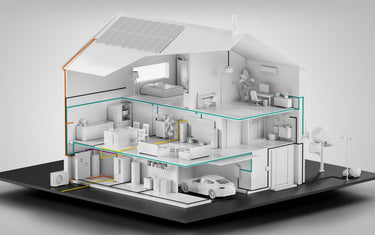
Modern building automation uses fieldbus and Ethernet networks to connect devices, controllers and BMS platforms. A building can also use fibre, wireless and dedicated safety cabling, but fieldbus and Ethernet are two key communication media, and they ask different things of the cable. Each is a different technology with its own electrical characteristics, network performance and installation environment. So the first step is to confirm which protocol and physical interface each system needs, and only then select the cable.
This guide sets out how to match LAPP fieldbus and Ethernet cable to the systems in a building. It builds on our pieces on data centre BMS and DCIM cabling, PROFINET cable selection and industrial Ethernet patch cords, and keeps to the part they leave open: the commercial or institutional building as a whole.
Which fieldbus cable fits which building system?
The cable follows the application and its bus. Each bus has its own electrical needs, so a cable built for one protocol should not be assumed to suit another. The first question is which protocols the building's lighting, HVAC, access and metering packages actually use. In practice a Southeast Asian project often mixes more than one, because each trade brings its own equipment.
Lighting, blinds and room control are where KNX is usually found. These systems spread small control signals across a whole floor, so the cable needs to be made for that bus. UNITRONIC® BUS EIB is a KNX/EIB bus cable for building management, and LAPP lists it for decentralised control of lighting, heating, air-conditioning, ventilation, energy management, blinds, time management and locking systems. The same family includes a halogen-free version, which matters where a specification restricts halogens in occupied spaces.
Metering, HVAC controllers and similar serial devices often use Modbus RTU over RS-485. For RS-485 and RS-422 based systems, LAPP lists UNITRONIC® BUS LD, a fixed-installation cable with a tinned copper braid screen, and names Modbus as an example application. BACnet MS/TP also runs over RS-485, but a cable that suits the RS-485 physical layer is not automatically right for every BACnet MS/TP installation. Characteristic impedance, capacitance, cable length, network topology and the device specifications all still matter, so check them with the device manufacturer and the project before you specify the cable.
Some specialist plant and packaged equipment brings its own bus. PROFIBUS DP is not a default building-services protocol, but it can arrive with industrial plant or packaged equipment. In that case UNITRONIC® BUS PB Yv is the matching cable, listed by LAPP for PROFIBUS DP. Equipment that uses CAN calls for a different cable again. UNITRONIC® BUS CAN is described by LAPP for CAN and CAN FD networks,.
Our earlier BMS article notes that Modbus over RS-485, BACnet, PROFINET and plain Ethernet each ask something slightly different of pair count, screen and impedance, which is why the protocol is settled before the cable.
Where does Ethernet belong in a smart building?
Ethernet carries building controllers, supervisory software, IP cameras and wireless access points, and it increasingly reaches IP-connected field equipment too. The same protocol family can sit on either medium: BACnet/IP and Modbus TCP run over Ethernet, while BACnet MS/TP and Modbus RTU run over RS-485. So check the physical interface of each device, not only the protocol name.
For fixed horizontal runs, ETHERLINE® LAN Cat.6 F/UTP 4x2xAWG23 LSZH is an example of what to look at. LAPP lists it for structured building cabling according to EN 50173 and ISO/IEC 11801, with a halogen-free sheath, a CPR fire class of Eca and support for Power over Ethernet up to IEEE 802.3bt (4PPoE). That last point is useful for access points and cameras that take power from the same cable.
Length still decides the design. A typical structured copper Ethernet channel allows up to 90 m of permanent link plus up to 10 m of combined equipment and patch cords, subject to the standards and the application. A device beyond that needs another approach rather than a longer cable. An industrial switch can start a new segment, for example the ETHERLINE® ACCESS U05T-E-T unmanaged switch (7433507951). For longer runs, such as a riser or a link to a separate plant building, a fibre-optic link avoids the copper limit and electromagnetic interference, for example HITRONIC® HUN1500 single-mode fibre cable. Application-specific extended-distance technologies are another option for some devices.
At the outlet, pre-assembled patch cords remove field termination. ETHERLINE® LAN Cat.6A patch cords are fully shielded (S/FTP), with RJ45 connectors made to IEC 60603-7-51. A good patch cord is only one part of the link, so verify the performance of the complete channel, not just the cord.
If part of the building runs PROFINET, for example a central plant or a building-services skid, ETHERLINE® PN Cat.5e FRNC FLEX FC is the flexible halogen-free option LAPP lists for PROFINET type B, with a Fast Connect design that shortens assembly time. Check the product page against the project's cable requirements before ordering.
How should fieldbus and Ethernet share a building without interfering?
Three checks keep a mixed installation under control.
First, look after segregation from power wiring, EMC, screen continuity and bonding, according to the relevant installation standards. Fieldbus and Ethernet do not always need separate containment from each other. The bigger concern is the power cable alongside them. The ETHERLINE® LAN Cat.6 page lists a segregation class of C according to EN 50174-2, and the installer needs to read that against the actual power cables in the same tray. We do not restate separation distances here, because they depend on the standard and the installation.
Second, match the fire behaviour to the space, and read each rating for what it covers. IEC 60332 deals with flame spread, IEC 60754 with halogen-acid gas behaviour, and CPR Eca is a reaction-to-fire classification. These are not interchangeable. LAPP lists flame retardance according to IEC 60332-1-2 for the UNITRONIC® BUS EIB cable, and halogen-free to IEC 60754-2 and CPR Eca for the Cat.6 cable. Check what your local authority and the project specification require before you order, as families often include both halogen-free and standard PVC versions under similar names.
Third, do not stretch a fixed-installation cable into a moving one. The bus and LAN cables above are listed for fixed installation. A cable that must move, for example at a sliding door or a rotating sensor mount, is a different selection, so read the installation type and bending radius on that product's page before you specify it.
These checks sit alongside protocol rules, which belong to the building-systems designer. The cable specification supports the protocol design. It does not replace it.
What does this look like in a real building?
Take a mid-rise office building with a central chiller plant in a separate block. Lighting and blinds on each floor run on KNX, so UNITRONIC® BUS EIB runs from the room controllers to the floor's line coupler. The energy meters and the chiller controllers talk Modbus RTU and BACnet MS/TP over RS-485, so the designer confirms the device requirements and then specifies a bus cable such as UNITRONIC® BUS LD.
On each floor, Cat.6 LSZH cable links the floor controllers, IP cameras and wireless access points back to the floor comms room, with PoE powering the cameras and access points. The riser between the floor comms rooms and the BMS server room, and the link to the chiller plant block, are longer than a copper channel allows, so they run on single-mode fibre. Three media, each chosen after the protocol and physical interface were confirmed.
Talk to Our Engineers
If a building automation project in Southeast Asia is mixing KNX, Modbus RTU, BACnet MS/TP or specialist plant buses with Ethernet, LAPP technical support can check the cable selection against the LAPP range and flag where a variant or a pre-assembled option saves time.
Contact LAPP technical support through the LAPP SEA enquiry page, and share the protocol, the physical interface, the longest run, the environmental conditions, the fire requirements and any PoE needs.


